
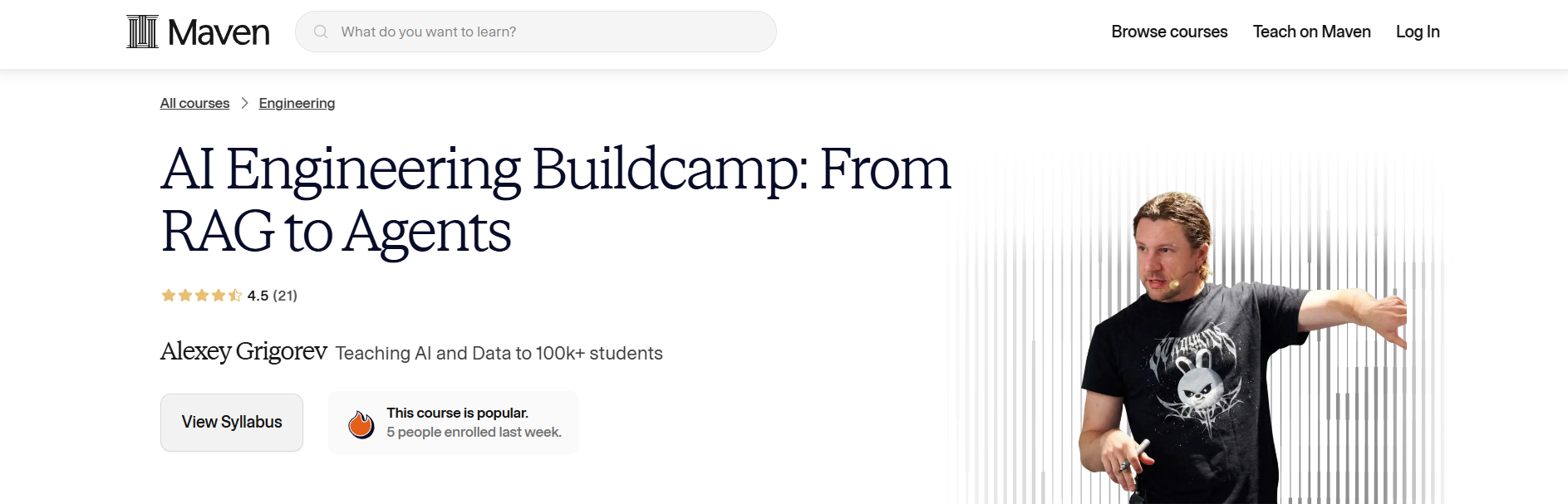
Alexey Grigorev – AI Engineering Buildcamp
$497.00 Original price was: $497.00.$45.00Current price is: $45.00.
- 24/7 Contact Support & Telegram - Ecomkevin_1
- You Can Request Any Courses
- Original Courses HD Qualite and links updated
Guaranteed Safe Checkout


Description
Alexey Grigorev – AI Engineering Buildcamp
Introduction
In today’s rapidly evolving digital world, artificial intelligence is no longer a futuristic concept—it’s a core driver of innovation across industries. From healthcare to finance, AI systems are transforming how businesses operate, make decisions, and deliver value. However, learning AI is one thing; building real-world AI systems that scale is an entirely different challenge. This is where Alexey Grigorev – AI Engineering Buildcamp stands out as a powerful and practical learning experience.
Created by Alexey Grigorev, a recognized expert in machine learning and MLOps, this buildcamp is designed to bridge the gap between theoretical knowledge and real-world AI engineering. It focuses not just on models, but on deploying, maintaining, and scaling AI systems in production environments.
What is AI Engineering Buildcamp?
The program is a hands-on, project-based training designed for developers, data scientists, and engineers who want to move beyond notebooks and build production-ready AI systems. Instead of focusing purely on algorithms, it emphasizes end-to-end AI pipelines, including data processing, model training, deployment, and monitoring.
Unlike traditional courses that stop at model accuracy, this buildcamp teaches how to make AI systems reliable, scalable, and maintainable in real-world scenarios. That’s the key difference—it’s not about experimentation; it’s about execution.
Why AI Engineering Skills Matter
Most aspiring AI professionals spend countless hours learning machine learning algorithms, yet struggle when it comes to deploying models into real applications. Companies don’t just need models—they need working systems.
AI engineering is the discipline that ensures models actually deliver value. It involves:
- Building data pipelines
- Automating workflows
- Deploying models using APIs
- Monitoring performance in production
- Handling real-time data
Without these skills, even the most accurate model remains unused. This is why programs like this buildcamp are becoming essential for anyone serious about a career in AI.
Core Features of the Buildcamp
1. Practical, Project-Based Learning
One of the strongest aspects of the buildcamp is its focus on real-world projects. Instead of passive learning, participants actively build AI systems from scratch. This includes:
- Designing end-to-end machine learning pipelines
- Deploying models into production
- Creating scalable architectures
By the end of the program, learners have a portfolio of practical projects that demonstrate real engineering capability.
2. Focus on MLOps
MLOps (Machine Learning Operations) is a crucial component of modern AI systems. The buildcamp introduces concepts such as:
- Continuous integration and deployment (CI/CD) for ML
- Model versioning
- Automated retraining pipelines
- Monitoring and logging
These are the skills that differentiate a beginner from a professional AI engineer.
3. Industry-Relevant Tools and Technologies
Participants gain hands-on experience with tools commonly used in the industry. This includes:
- Docker for containerization
- Cloud platforms for deployment
- Workflow orchestration tools
- APIs for serving models
Learning these tools ensures that students are job-ready and capable of working in real production environments.
4. Structured Learning Path
The buildcamp follows a structured progression:
- Foundations of AI engineering
- Data processing and pipelines
- Model development
- Deployment strategies
- Monitoring and optimization
This step-by-step approach ensures that learners build confidence as they advance through increasingly complex topics.
Who Should Join This Buildcamp?
This program is ideal for:
- Data scientists who want to move into production-level work
- Software engineers interested in AI systems
- Machine learning enthusiasts aiming to build real applications
- Professionals looking to upgrade their AI skill set
While some basic knowledge of programming and machine learning is helpful, the focus is on practical implementation rather than theoretical complexity.
Real-World Applications You’ll Learn
The skills gained from this buildcamp can be applied across multiple industries. Some examples include:
1. Recommendation Systems
Learn how to build systems that suggest products, content, or services based on user behavior.
2. Predictive Analytics
Develop models that forecast trends, such as sales predictions or customer churn.
3. Computer Vision Applications
Deploy models that analyze images and videos for real-time insights.
4. NLP-Based Systems
Create applications like chatbots, sentiment analysis tools, and document processing systems.
Benefits of Joining
1. Career Advancement
AI engineering is one of the most in-demand skills globally. Completing this buildcamp can significantly improve job prospects and open doors to high-paying roles.
2. Hands-On Experience
Instead of just learning theory, participants gain real-world experience that employers value. This practical exposure is often the missing piece in traditional education.
3. Portfolio Development
By the end of the program, learners have multiple projects that showcase their ability to build and deploy AI systems. This is a major advantage when applying for jobs.
4. Industry-Relevant Knowledge
The buildcamp focuses on what companies actually need, making it highly relevant for real-world applications.
How It Stands Out From Other Courses
There are countless AI courses available online, but most focus on:
- Mathematical theory
- Model training
- Academic concepts
Very few teach how to deploy and maintain AI systems in production. This is where this buildcamp excels.
It shifts the focus from “learning AI” to “building AI systems that work in the real world.”
Learning Outcomes
After completing the buildcamp, participants will be able to:
- Design scalable AI systems
- Deploy machine learning models as APIs
- Build automated pipelines
- Monitor and improve model performance
- Work with real-world datasets
These outcomes align closely with what companies expect from AI engineers.
Challenges You May Face
While the buildcamp is highly rewarding, it’s not without challenges:
- Requires consistent effort and practice
- Involves learning multiple tools and technologies
- Demands problem-solving and debugging skills
However, these challenges are part of the learning process and ultimately contribute to skill development.
Tips to Succeed in the Buildcamp
To get the most out of the program:
- Stay consistent with your learning schedule
- Practice building projects regularly
- Focus on understanding concepts, not just completing tasks
- Experiment with different approaches
- Engage with the community for support
Success in AI engineering comes from practice and persistence.
Future of AI Engineering
AI engineering is rapidly becoming one of the most critical roles in technology. As companies continue to adopt AI, the demand for professionals who can build and deploy systems will only increase.
Programs like this buildcamp are shaping the next generation of AI engineers by providing practical, real-world training that aligns with industry needs.
Final Thoughts
Alexey Grigorev – AI Engineering Buildcamp is more than just a course—it’s a comprehensive pathway to becoming a skilled AI engineer. By focusing on real-world applications, practical projects, and production-level systems, it prepares learners for the challenges of modern AI development.
If you’re serious about building a career in AI and want to move beyond theory into real implementation, this buildcamp offers a strong foundation and a clear direction.
Reviews
There are no reviews yet.